15 April 2026
Explore learning from our small bursary grants pilot focused on supporting organisational strengthening.
Mhairi Reid
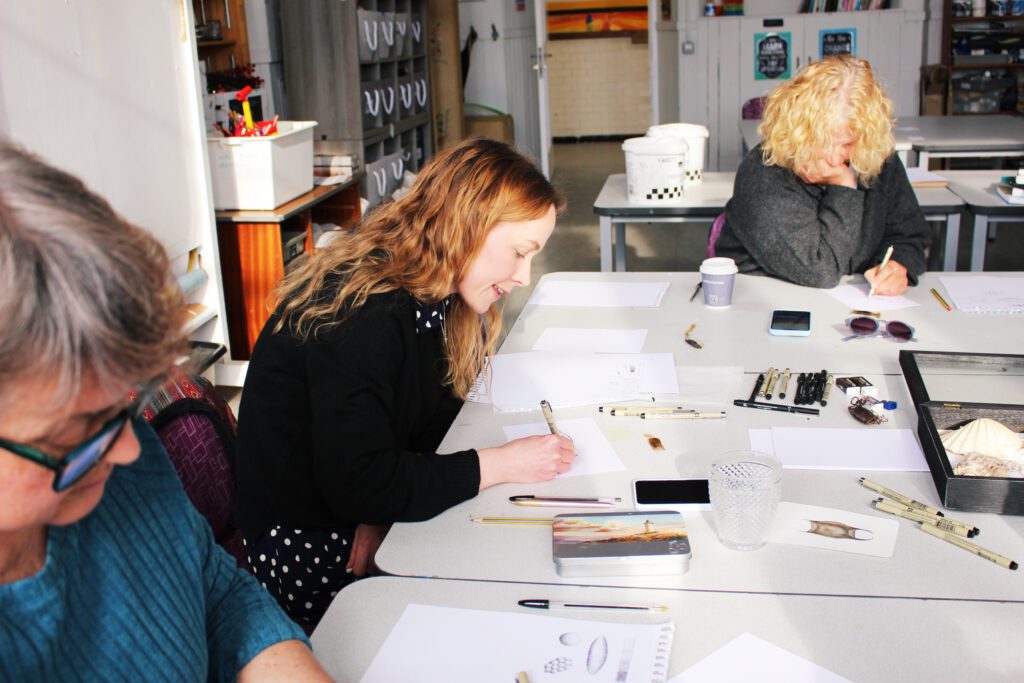
Photo: Argyll Hope Spot artists’ workshop.
In our recent blog about learning questions, we shared how these prompts are helping us pay attention to the change we want to contribute to. As we explored one question – What becomes possible when partners have flexible funding? – we noticed something important: flexible grants, while hugely valuable, don’t automatically lead to the organisational strengthening we hope they might enable.
Even when funding is flexible, organisations often prioritise delivery because investing internally can feel hard to justify. Grantees have described feeling uneasy about spending money on people, systems, strategies or governance when demand for their services is so high – even when this inward investment would ultimately strengthen their work.
Paired with our second learning question – Which aspects of our ways of working contribute to regenerative outcomes? – this helped us reflect on our Funder Plus offer and how we add value beyond the grant. It prompted us to ask:
- Are there ways we can support organisational strengthening more directly?
- How do we do that without adding burden or undermining trust?
- And how can we do it in a way that contributes positively to the wider ecosystem?
We wanted to explore what a small amount of money restricted for organisational strengthening could achieve, when funded partners could choose what to use it for. This led us to test a small Funder Plus bursary grants pilot with around ten grantees.
Several partners have described hesitation about using funding for inward‑facing work, even when it would ultimately strengthen their organisation. Read more in our blog, Looking under the bonnet.
What is the bursary pilot?
The bursary offers up to £5,000 of restricted funding for grantees to invest in strengthening their organisations. It’s intentionally small, relational and exploratory. Over the next six months our aim is to learn:
- what organisations choose when explicitly prompted to invest inwardly
- how our approach shapes those choices
- what value a small, focused intervention can add alongside a grant
We created a shortlist based on existing intelligence from our relationships and conversations, thinking about who could benefit from a bursary right now. The shortlist also includes a representative spread across our grant-making themes. We then had open conversations with grantees to develop the ‘ask’ together, and we approved bursaries on a rolling basis. This lighter, relational approach is consistent with our broader grant‑making and has generated useful learning in itself.
The mix of bursaries we’re supporting reflects a range of organisational needs – from improving digital communications expertise and income‑generation planning to investing in evaluation, staff development, partnership‑building and collective strategy work.
What we’re learning so far
1. Calling it a pilot helps everyone
Framing this as a pilot has helped manage expectations and given us permission to be exploratory and flexible. This isn’t a one‑off judgement about grantees’ needs. If the timing isn’t right, or they want more space to think, we can revisit the conversation later once we’ve learned more.
2. Our relational approach matters
By revisiting reports and previous conversations before reaching out, we were able to start from what organisations had already told us. This meant the conversations started from a deeper point of understanding and helped build trust. This, in turn, helped make the process feel more collaborative, honest and grounded in what organisations themselves had identified.
3. Don’t rely on assumptions
We don’t want to narrow the scope of what’s possible by assuming we know what’s needed, so we’re staying as open as possible in our conversations. We’re learning about how to offer just enough guidance to ensure that partners don’t default to expanding delivery because it’s familiar.
The conversations themselves have been a key source of learning. They’ve helped us understand organisational context more deeply and co‑develop the ‘ask’ over time. For some, proposals aligned very closely with what we anticipated. For others, the bursary is now being used for something quite different from what we initially expected.
This mix is useful: it helps us understand both where our instincts are right and where conversation reveals something different. A good example came from a conversation where we initially thought the bursary might support leadership development, but it transpired that a deeper priority was strengthening staff capacity through skills development and training.
We’ve also supported the evolution of ideas from bringing in consultants to “deliver for” into support that “works alongside” and builds internal capability where possible.
4. A rolling approval helps us stay responsive
Some organisations are ready to move quickly; others need more space to think. Approving bursaries on a rolling basis avoids unnecessary competition or deadlines, reduces burden and lets support develop at a natural pace and in a way that suits different organisational contexts.
5. A bursary can support good endings too
Another emerging insight is how the bursary could play a role at different stages of a funding relationship – including, potentially, where a small, focused piece of support could be useful as relationships shift or conclude.
A bursary could help ensure that when a relationship moves towards an ending, it does so in a way that still leaves the organisation better equipped – a regenerative transition rather than a sudden drop‑off.

Read more about third sector support for regenerative transitions in our Empowering Endings blog.
What next
This small pilot is already helping us understand how organisations articulate their needs when given space to think about their capacity – and how our ways of working can stay simple, flexible and genuinely useful.
Over the coming months, we’ll continue listening closely to the organisations involved. Capturing the learning will help us understand whether and how bursaries could fit within future versions of our Funder Plus offer- and whether some examples point more clearly to how unrestricted funding could be used instead. These nuances are exactly why a pilot approach is valuable.
We’re keen to share what we learn in ways that make a positive contribution to the wider ecosystem we’re part of. If you’d like to chat with us about the bursary pilot or compare notes, we’d be very happy to hear from you.
Email us at foundation@wgrant.com.