14 April 2026
Accelerating a fair transition to renewable energy: Regen.
William Grant Foundation

Key learnings:
- Independent, early‑stage research helps bring community perspectives into clean energy conversations that are often dominated by government, industry and technical experts.
- Community capacity is a vital – but often missing – ingredient in enabling fair participation in the clean energy transition.
- Shared ownership can give communities a meaningful stake in clean energy projects, but progress depends on governments and other bodies taking action to remove practical and structural barriers.
- Flexible grants can play a catalytic role by supporting the early analysis, convening and experimentation that larger funding streams are often not designed to back.
Regen is an independent centre of energy expertise, working across the UK to accelerate the transition to a clean energy system. A core part of their work focuses on ensuring that this transition is fair, inclusive, and accessible.
With funding from our Natural and Built Environment strand, Regen’s Just Transition and Communities team has been exploring how communities can meaningfully participate in – and benefit from – the move to net zero, and what currently stands in their way.
As Grace Millman, Regen’s Just Transition & Communities Lead, explains:
“A fair transition isn’t just an outcome – it’s about the process that gets us there, and who is involved along the way. Fairness needs to be designed in from the start.”
Our funding supported two linked pieces of work: Sharing Power, which explores how shared ownership can support a faster and fairer rollout of renewable energy, and Building Blocks, which examines the role of community capacity in the energy transition.
Enabling shared ownership
Sharing Power, looks at shared ownership – where communities take a financial stake in renewable energy projects alongside developers.
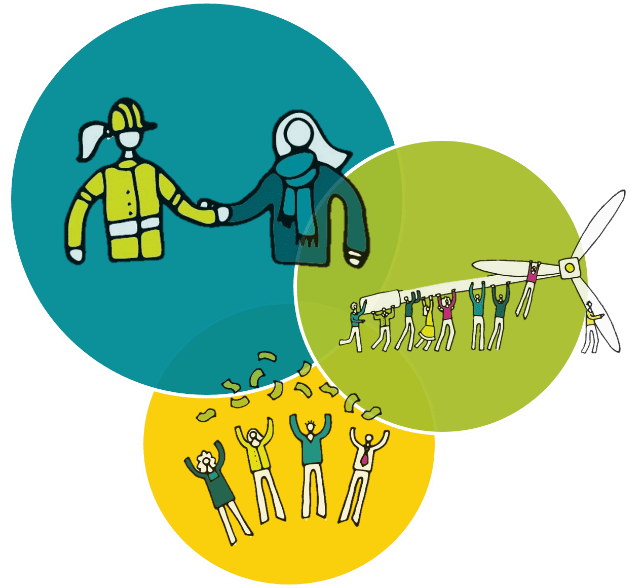
Read Regen’s research into unlocking shared ownership for a fast and fair clean energy transition.
Regen’s research shows that shared ownership can help build trust, increase local support for renewable energy, and generate income that communities can reinvest in local priorities.
It can also offer a more accessible route for communities that lack the resources or confidence to develop projects independently.
As Jess Hogan, Project Manager, says:
“Shared ownership can be a really powerful middle ground – it helps bring people along while still enabling projects to move quickly at scale.”
At the same time, the research highlights the barriers that currently limit uptake. These include low awareness, lack of community capacity, difficulties accessing finance, overly complex processes, and uncertainty around roles and responsibilities.
Importantly, this work landed at a moment of growing policy attention. The lifting of onshore wind restrictions, the creation of Great British Energy (the UK’s publicly-owned renewable energy investment body) and forthcoming consultations on shared ownership have created a real window for influence. And as a lead Scottish Government & public sector partner on clean energy they have a key role to play in ensuring the benefits of shared ownership reach communities across Scotland.
Regen’s analysis is already informing policy discussions and helping to shift shared ownership from a niche concept into mainstream energy conversations.
Building community capacity
As energy systems become more local and renewable, there is growing opportunity for communities to play an active role in shaping, leading and benefiting from the clean energy transition. Regen’s Building Blocks research explores what this requires in practice.
The report shows that while interest in community‑led energy is high, the ability to engage varies widely between places. As Robbie Evans, Energy Analyst at Regen, says:
“Years of austerity, rising living costs and pressure on local organisations have reduced the time, capacity and support available in many communities – particularly those already facing disadvantage.”
Regen’s research challenges narrow definitions of capacity that focus mainly on technical skills. Instead, it highlights capacity as a broader mix of people, relationships, skills, funding, institutions and local knowledge – all of which are needed to move from ideas to delivery.
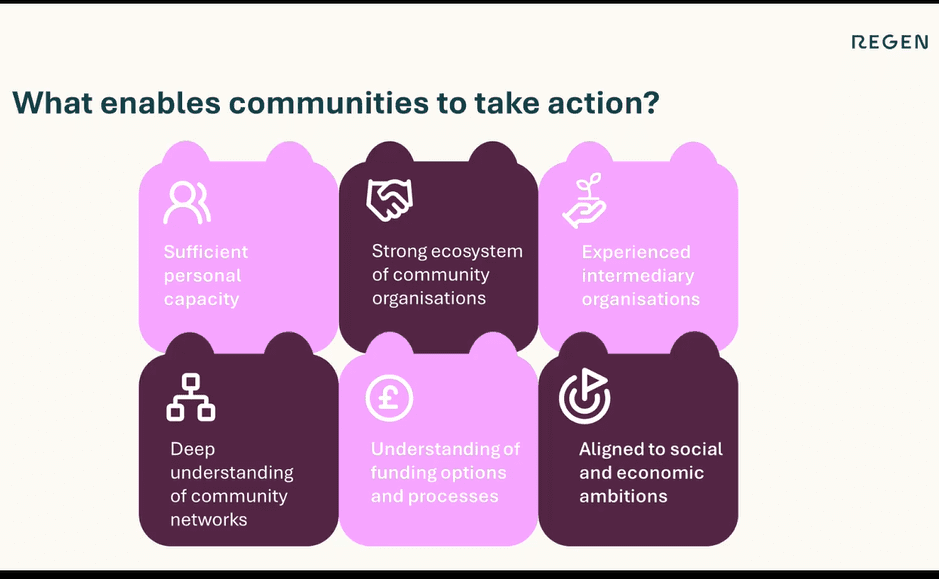
Watch Regen’s webinar on the ‘Building blocks’ research.
Drawing on interviews with community organisations, intermediaries, policymakers and practitioners (most based in Scotland), the report identifies a set of conditions – or building blocks – that underpin more successful, inclusive community‑led energy action. These include strong local ecosystems and trusted relationships, experienced intermediary support, time for early engagement, and clear, navigable funding routes.
The research also points to the risk of inaction. Without deliberate effort to address gaps in capacity, the expansion of local and community energy risks reinforcing existing inequalities – with already‑resourced communities best able to benefit from new opportunities.
The report sets out practical recommendations for governments, local authorities and intermediaries. These include multi‑year funding for capacity building, targeted support for communities with the greatest need, and greater recognition of the value of slow, relationship‑based work.
Since publication, the findings have sparked active and new conversations across the sector, including with Great British Energy, local authorities and community organisations. The recent publication of the Scottish Just Transition Commission’s concluding report – which includes recommendations around community right to shared ownership and addressing social infrastructure capacity – offers further opportunities for this research inform what happens next in Scotland’s clean energy transition.
The value of independent, early funding
For Regen, independent funding from the Foundation played a crucial role in enabling this work at the right moment. As Grace says:
“It created space to step back, bring together evidence, test ideas and engage widely, and enabled us to respond to new developments within the sector .”
This combination of research, convening and policy engagement has strengthened Regen’s role as a trusted voice in just transition debates, while helping ensure that perspectives from under‑represented communities are part of the picture.
Looking ahead
Fair participation in the clean energy transition depends not just on ambition or policy intent, but on having the right conditions in place.
With key policy decisions on renewable energy expected over the next year, and growing recognition that community capacity underpins a fair transition, Regen’s work is entering a new phase.
The focus is shifting from why these approaches matter to how they can be implemented well in practice – particularly in places with the least capacity to engage.
This is where independent evidence and practical insights from communities really count. By helping shape how policy and delivery approaches are designed now, Regen’s work has the potential to positively influence who benefits from the clean energy transition for generations to come.
Learn more and stay connected to Regen’s work.